

One wedding or school day can leave you with thousands of frames and a weekend of sorting. Photo culling software now splits two ways: tools that make the first cut for you, and tools that flag problems so you decide faster. Here are eight worth a look, and who each one suits.
TL;DR: Best AI Photo Culling Software at a Glance
- Evoto: best for AI culling and portrait retouching in one app
- Aftershoot: best for fully automated culling on high-volume shoots
- Narrative Select: best for AI-assisted culling where you keep full control
- Imagen AI: best for culling to a target count, then AI editing
- FilterPixel: best for sports, event, and conference photographers
- Excire Foto: best for local, offline, highly configurable culling
- Lightroom Assisted Culling: best if you want to stay inside Adobe
- Capture One Assisted Review: best for Capture One and tethered studio work
1. Evoto
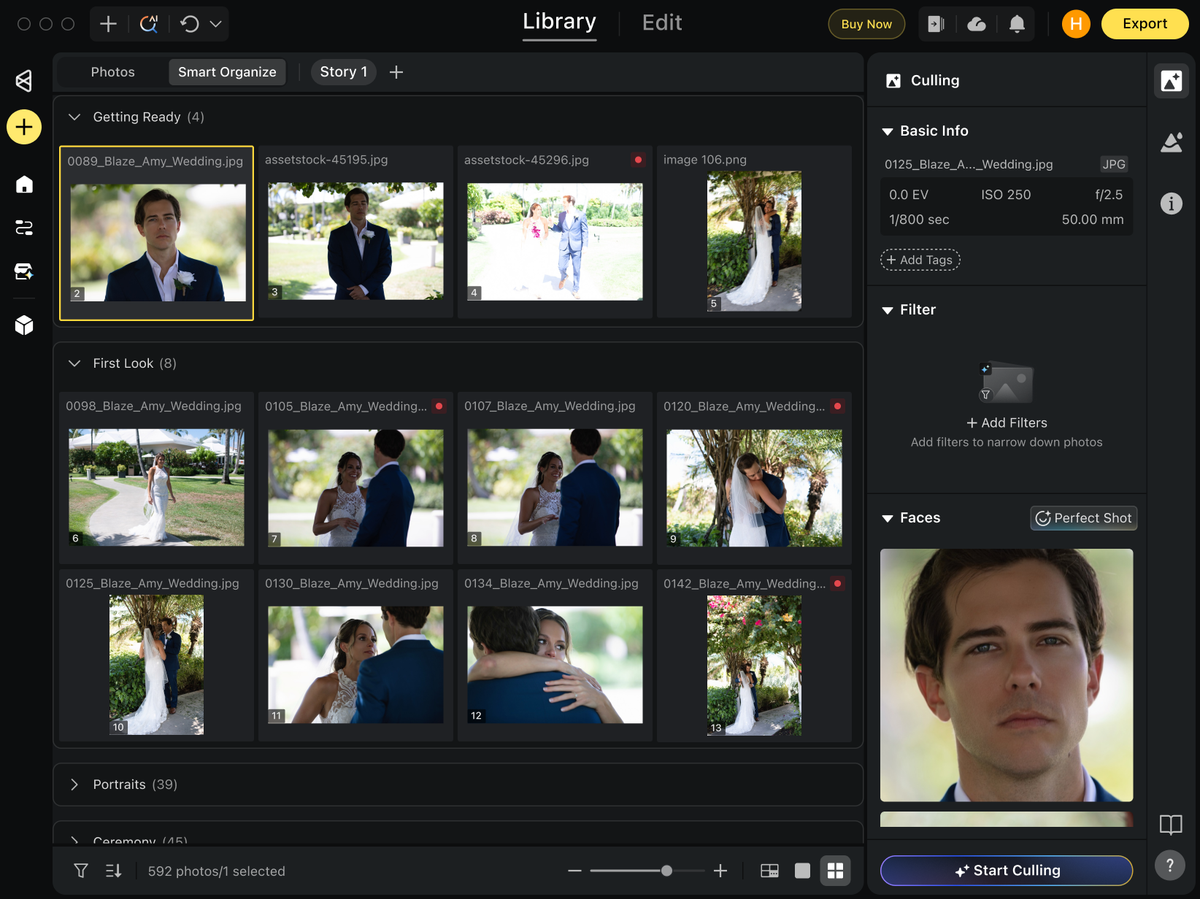
Evoto is an AI photo editor for working photographers, and the AI-powered culling lives in the same Library where you later retouch and export. If your selects go straight into portrait work, that saves an export and a second app.
Best for: wedding, school and graduation, event, headshot, and e-commerce photographers who want culling and retouching in one place.
What stands out:
- You can cull by hand or let the AI do it in the Library panel, with three strength levels. Rejected frames are sorted into blur, overexposure, underexposure, and closed eyes, and near-duplicate bursts are narrowed to the strongest frame.
- Best Picks aren’t ranked on sharpness alone. The AI also weighs expression, lighting, and composition, and applies the same criteria across the whole shoot.
- The AI Culling Dashboard collects Best Picks, candidates, quality issues, faces, and clusters. Each card opens the matching photos, so you can jump straight to every frame flagged for a quality issue.
- Story-based Culling & Segments splits a shoot into chapters by People or Scene. Segmentation and culling start from one setup, and you can filter and deliver segment by segment.
- Culling Scores, Search by Text, Face Filters, Custom Tags, and Workflow Templates run a repeat job from import to delivery.
- For on-site sales, Evoto Instant can cull at upload, checking for blinks, blur, exposure problems, and duplicates, so only frames that pass make it into the upload.
Where it falls short: AI culling runs on a whole project, so you can’t run it on just one folder or Collection.
Pricing:
- AI Culling: free to use, no subscription required
- Credits: charged per photo at export, only for the paid features you apply
- Annual credit plans: from US$80 a year for 800 credits (see plans)
- Free trial: 7 days for new accounts (Limited Offer)
Platforms: AI culling is available on both macOS and Windows.


The Best AI Photo Culling Software
2. Aftershoot
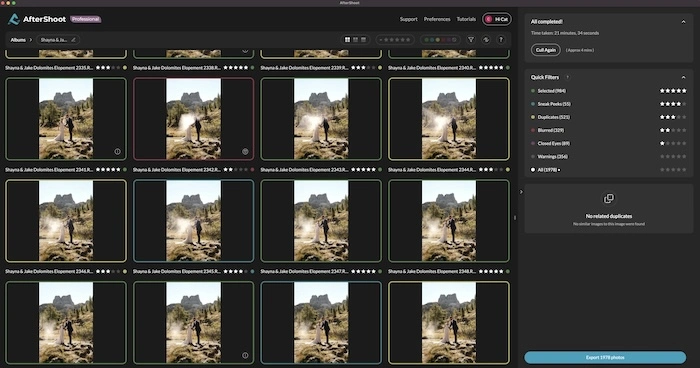
Aftershoot says more than 100,000 photographers use it, and it’s the strongest pick here if you want the AI to make the first cut on its own. You choose between AI Automated Culling for a hands-off pass and AI Assisted Culling when you’d rather make the calls yourself.
Best for: high-volume wedding and event photographers who want fully automated culling.
What stands out:
- Duplicate grouping that tries to tell true duplicates apart from creative variations of the same moment
- Key Face detection and scores, plus Survey Mode and a Spray Can tool for rating many frames quickly
- It learns from how you cull, and it works offline, so your files stay on your machine
- Direct export to Lightroom, Lightroom CC, Capture One, Bridge, and Adobe Camera Raw (ACR)
Where it falls short: editing and retouching are separate modules, so the full cull-to-retouch setup costs noticeably more than culling alone. Fully automated picks still need a human pass on the emotional moments.
Pricing (Aftershoot pricing):
- Select (culling only): US$15 a month, or US$7.50 a month billed yearly
- Complete (cull, edit, and retouch): US$55 a month, or US$33.75 a month billed yearly
- Free trial: 30 days, no card required
Platforms: macOS Catalina or later and Windows 8 or later, with at least a 4-core CPU and 8GB of RAM.
3. Narrative Select
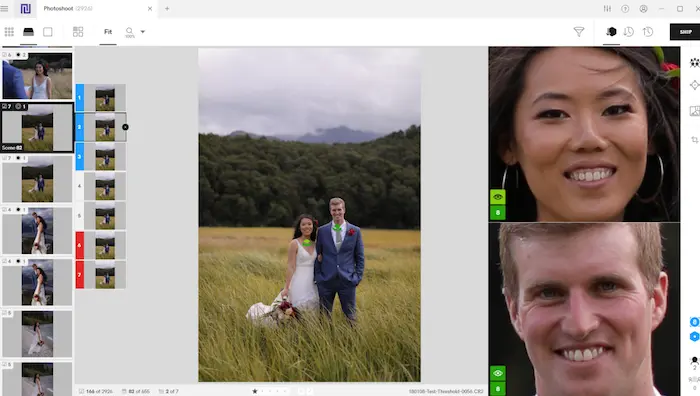
Narrative Select won’t make your picks. It gives you fast previews and face-level information, then leaves every decision to you. That’s why the reviewer at Adventure Wedding Academy picked it over Aftershoot. Its Scenes View groups similar frames and ranks them, so the best shot of each moment sits at the front.
Best for: photographers who want AI to speed them up but insist on choosing every frame themselves.
What stands out:
- Image rendering with no lag as you move between frames
- Eye and focus assessments shown as color-coded icons under each face, turning red when someone blinks
- A Close-ups panel that crops in on every face in the photo
- Selections and ratings ship straight to Lightroom, Photoshop (Camera Raw), or Capture One
Where it falls short: there’s no fully automated cull, and the face assessments aren’t in the entry plan. The same review notes that you can’t rename or back up files during import.
Pricing (billed yearly, Narrative pricing):
- Lite: US$10 a month
- Standard: US$20 a month (adds eye and focus assessments)
- Premium: US$40 a month
- Ultra: US$60 a month
- Free trial available
Platforms: macOS 12 or later, or Windows 11 with a quad-core 2GHz processor, 8GB of RAM, and a 2GB graphics card. There’s no iPad version.
4. Imagen AI
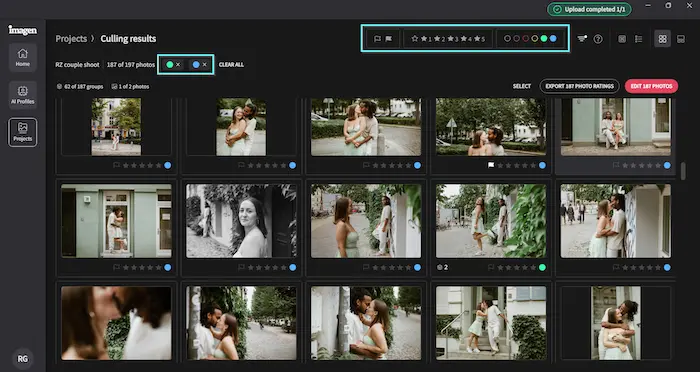
Imagen ties culling to its AI editing profiles, so the selects you review already carry your edit. You can also tell it to keep an exact number or percentage of the shoot. That helps when a contract promises a client a set gallery size.
Best for: photographers who want to cull to a target count and go straight into editing in their own style.
What stands out:
- Face recognition and duplicate detection
- Blur and closed-eye marks as you review, plus kiss recognition, since not every closed-eye frame is a reject
- Cull to Exact Number, by count or percentage
- Cull Edited Previews, which shows your frames with your AI Profile already applied
Where it falls short: Imagen processes in the cloud, so upload time becomes part of your workflow. The unlimited plan is also a big jump in cost if all you need is culling.
Pricing (Imagen pricing):
- Pay-as-you-go: US$7 monthly base fee, plus the AI culling add-on from US$12 a month
- Limitless (unlimited culling and editing): US$129 a month billed yearly, or US$165 month to month
- Free: two culling projects for new accounts
Platforms: macOS 10.13 or later (Intel or Apple Silicon) and 64-bit Windows 10 or later.
5. FilterPixel
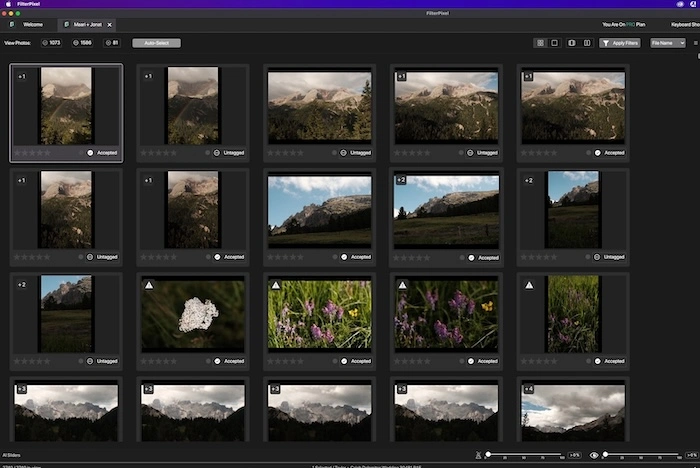
FilterPixel is built for photographers on deadlines, with separate genre modes for conferences, sports, concerts, and weddings. Its Magic Number feature lets the AI decide how many frames to keep, and each photo gets a score with a reason, so you can see why a frame was dropped.
Best for: sports, event, conference, and concert photographers who deliver fast.
What stands out:
- Genre-specific culling (DeepCull) tuned for different kinds of shoots
- Score and reason shown for every photo, plus custom filters to edit the scoring criteria
- RAW files stay on your computer, and only previews are uploaded
- Unlimited basic culling and editing on every plan
Where it falls short: DeepCull is capped per year, so a busy season can mean paying for extra shoots. FilterPixel also doesn’t publish minimum system requirements.
Pricing (billed annually, FilterPixel pricing):
- Standard: US$7.50 a month (20 DeepCull shoots a year)
- Pro: US$17.50 a month
- Studio: US$32.50 a month
- Extra DeepCull shoot: US$7.99
- Free trial: three DeepCull shoots and 3,000 photos, no card needed
Platforms: macOS and Windows. Its help center notes some Apple silicon Macs need Rosetta installed.
6. Excire Foto
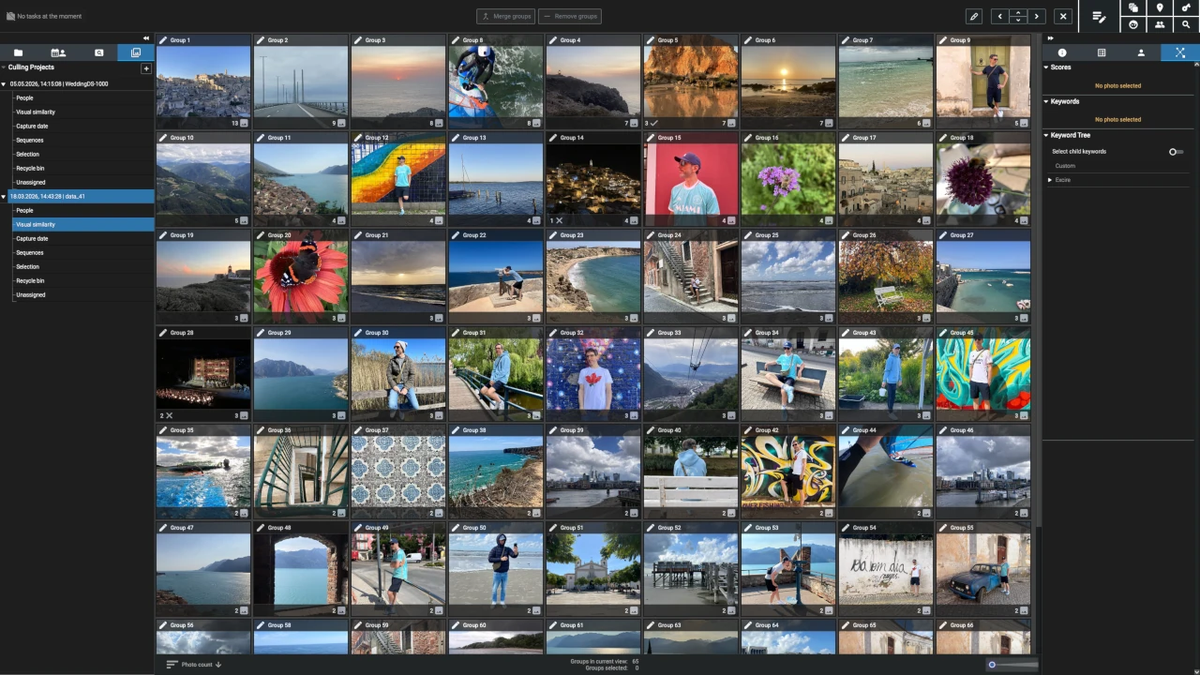
Excire Foto 2027 is a photo manager with a full culling module, and all of its AI runs on your own computer. Nothing is uploaded, and you pay once instead of subscribing.
It offers more ways to group and score photos than anything else on this list, which is both its appeal and the reason it takes a while to learn.
Best for: photographers who care about privacy, work offline, or want to fine-tune every culling setting.
What stands out:
- Grouping by people, scene, sequence, content, or capture date
- Sorting by aesthetics, sharpness, and facial expressions
- Smart selection with predefined or custom culling profiles you can reuse
- Survey View and a focus peaking mode for checking sharpness at a glance
Where it falls short: there are no editing tools, so you’ll still hand your picks to Lightroom, Capture One, or another editor. The number of settings also means a steeper start than most tools here.
Pricing (Excire shop):
- Excire Foto 2027: one-time US$249 (€229) license
- Upgrade from Excire Foto 2025: US$79
- Free trial: 14 days
Platforms: macOS 12 or later and 64-bit Windows 11, with 8GB of RAM minimum and 16GB recommended.
7. Lightroom Assisted Culling
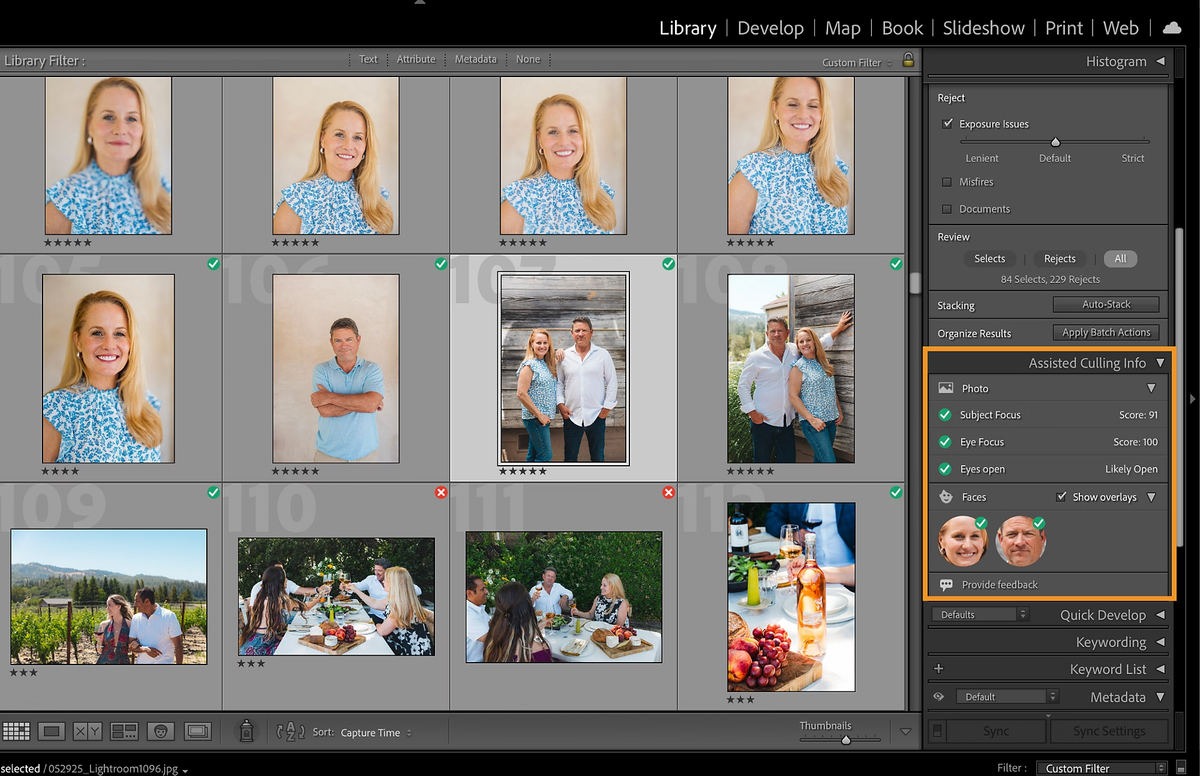
If your workflow already lives in Lightroom, Assisted Culling is the obvious place to start, because you’re already paying for it.
Adobe launched this AI-powered culling tool in Lightroom and Lightroom Classic at Adobe MAX in October 2025, as an early-access feature. The AI scores subject sharpness, eye sharpness, and open eyes, then sorts frames into Selects and Rejects against a 0 to 100 threshold you set.
Best for: photographers who want AI culling without adding another app.
What stands out:
- It checks each face separately in group photos
- It flags exposure problems and accidental shots, as well as focus
- Thresholds are adjustable, so you decide how strict the sharpness check is (Adobe’s walkthrough)
Where it falls short: it catches technical problems but doesn’t judge expression or story. Early reviews were mixed, and one Digital Camera World test found closed-eye frames slipping through as Selects. For a closer look at where it stops, see our Lightroom culling vs. AI culling software comparison.
Pricing:
- Included with Adobe Lightroom plans
Platforms: macOS and Windows.
8. Capture One
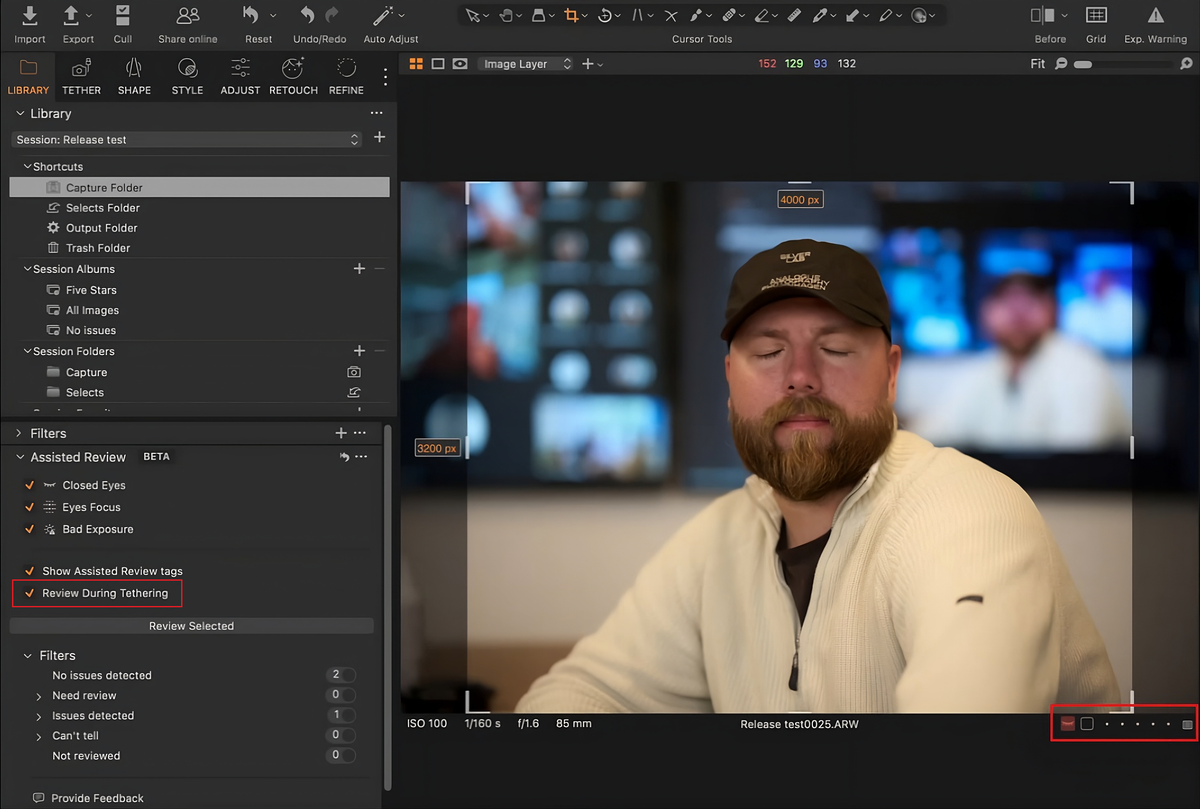
Capture One added Assisted Review as a beta in version 16.8 (May 2026). It uses AI to tag images with closed or out-of-focus eyes and exposure problems, and it can run while you tether, tagging frames as they land.
Since 16.9, it also draws a colored frame on each face in the Viewer: green, yellow, red, or grey, depending on what it finds.
Best for: studio and tethered shooters who already work in Capture One.
What stands out:
- Tags you can filter by, use in Smart Albums, and combine with star ratings and color tags
- Analysis during tethering, so problem frames are flagged before the session ends
- Face-by-face evaluation shown right on the image
Where it falls short: it’s still a beta, and it flags problems rather than picking the best frame from a burst. Capture One describes it as a tool to support your own judgement, not replace it.
Pricing:
- Included with Capture One
Platforms: macOS and Windows.
Fully Automated vs. AI-Assisted Culling: Which One Do You Need?
If you shoot thousands of frames and deliver within days, let the AI make the first cut. If you shoot fewer frames and every one matters, a tool that flags problems and leaves the picks to you is usually faster than correcting an automated cull.
So the choice comes down to how much of the decision you want to hand over. Accuracy claims matter less than that.
Automated tools make the keep-or-reject call on their own: Aftershoot’s Automated mode, Imagen’s Cull to Exact Number, FilterPixel’s Magic Number. They’re fast. The risk is losing a frame the couple would have loved, like a mid-laugh shot with half-closed eyes.
Assisted tools group, score, and flag, then wait for you. Narrative Select, Excire, Lightroom, and Capture One all work this way. You still make every call, but you no longer open the blurry and blinking frames one by one.
Why We Built Evoto’s Culling to Work Both Ways
We didn’t want Evoto to force that choice. You pick one of three culling strength levels, and the AI sorts whatever it drops into blur, overexposure, underexposure, and closed eyes, so any rejected frame is easy to find and bring back.
On the AI Culling Dashboard, Best Picks and candidates sit apart from the quality issues. Run it hands-off on a school day, or treat it as a first pass on a wedding.
Catching blur, missed focus, closed eyes, bad exposure, and near-duplicates is the part most AI tools on this list already do. The harder job is judging a frame the way a photographer would, and that’s where we’ve pushed further.
Evoto weighs expression, lighting, and composition when it ranks Best Picks. Story-based Culling & Segments then splits the shoot into chapters by People or Scene, so you can check that the first dance and the family formals are both covered before you deliver.
What no culling AI knows is your intent. A deliberately dragged shutter, a slightly soft frame you keep for the expression, the one photo with the bride’s grandmother in it: those calls stay with you. Evoto’s picks arrive as ratings and flags you can change, so your final review happens right where you culled.
Quick Decision Checklist
| Your situation | What to look for | Tools that fit |
|---|---|---|
| Thousands of frames per shoot and a tight turnaround | An automated first pass, then a quick look at the rejects | Evoto, Aftershoot, FilterPixel |
| You often keep “imperfect” frames for the emotion | Assisted culling, or adjustable strength with rejects sorted by reason | Evoto, Narrative Select, Excire |
| Weddings and events you deliver moment by moment | Grouping by scene or person, so every part of the day is covered | Evoto, Narrative Select, Excire |
| Your contract sets a gallery size | Cull to an exact number or percentage | Imagen, FilterPixel, Evoto |
| Privacy or slow internet is a concern | Local processing or preview-only uploads | Excire, Aftershoot, FilterPixel |
| Your selects go straight into portrait retouching | Culling and retouching in one app | Evoto |
| You already live in Lightroom or Capture One | The built-in tool, before paying for another app | Lightroom Assisted Culling, Capture One Assisted Review |
The One App That Handles Both AI Culling and Retouching
After most shoots, photos pass through two or three apps: one to cull, one for color, and another for retouching. Imagen and FilterPixel pair culling with color editing, and Aftershoot covers retouching once you add its Retouch module.
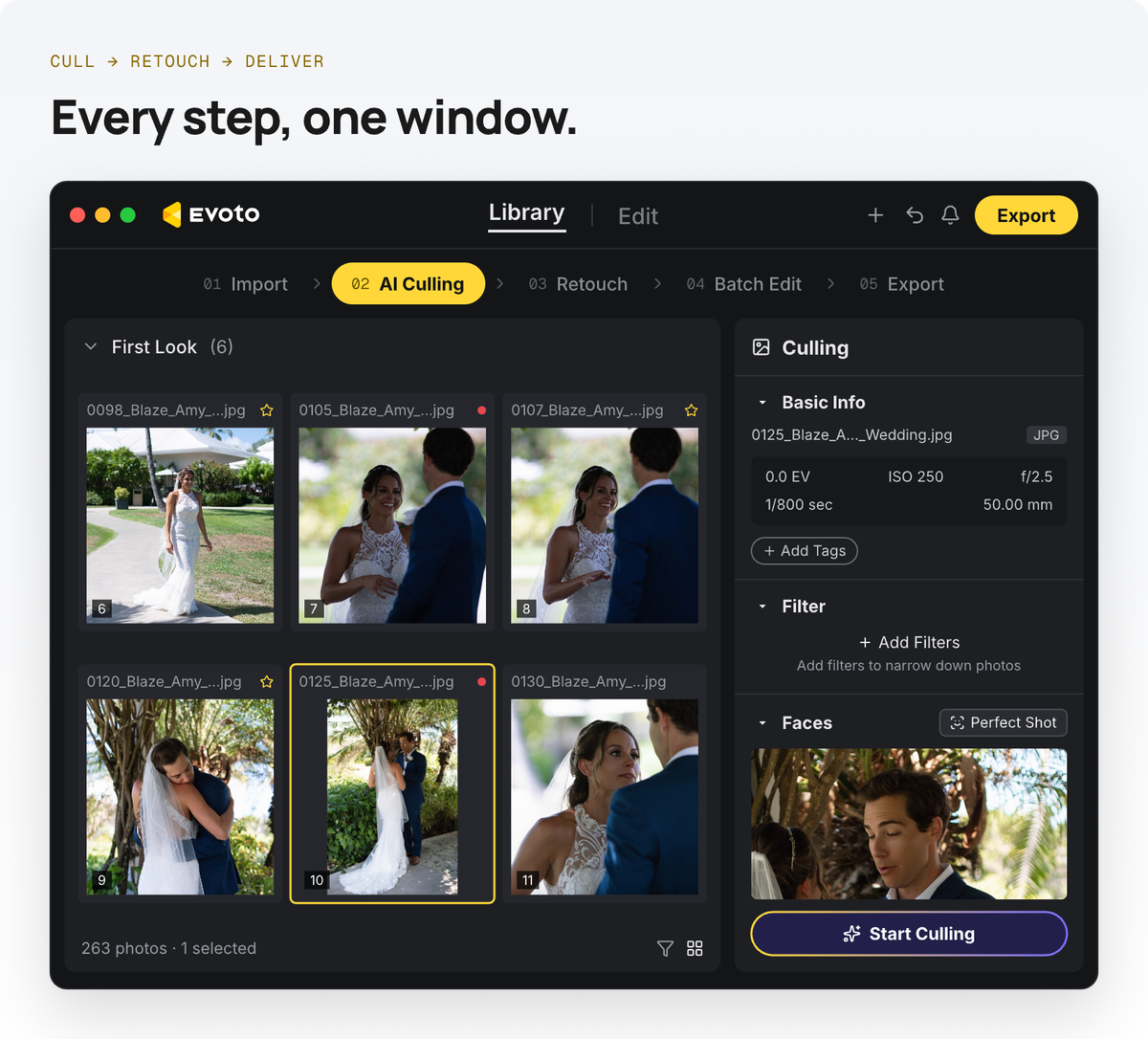
Evoto keeps the whole path in one place. Your Best Picks open straight into AI portrait retouching, batch editing, and export, with no export and re-import between apps. Workflow Templates save that setup, so the next job runs from import to delivery the same way.
If Lightroom Classic is still home base, Lightroom Classic Collaboration brings your catalog images into Evoto and sends crop, rotation, and flip changes back.
We walk through it in our standalone cull, color, and retouch workflow and our batch portrait editing workflow.
Which Photo Culling Software Should You Choose?
Pick Aftershoot for hands-off speed, Narrative Select or Excire for control, and the built-in Lightroom or Capture One tools if you don’t want another app.
If your selects go on to portrait retouching, Evoto handles the AI-assisted cull and the retouch in one app, and its AI culling costs nothing to run. Download Evoto and try it on your next shoot.
The Best AI Photo Culling Software