

For photographers, taking the photos is only half the job. The other half is delivering them in a way that feels fast, professional, and easy for clients to use.
That is why so many photographers eventually ask the same question: what is the best way to deliver photos to clients?
The short answer is this: the best method depends on the type of photography you do, but for many modern client-facing jobs, a gallery-based delivery setup is often more effective than sending loose files through email, cloud drives, or messaging apps. It usually creates a cleaner handoff, a better client experience, and more control over how photos are viewed, downloaded, and shared.
For many photographers, the best way to deliver photos to clients is no longer a generic file link. It is a delivery experience that feels clear, professional, and easy to use from the first click.
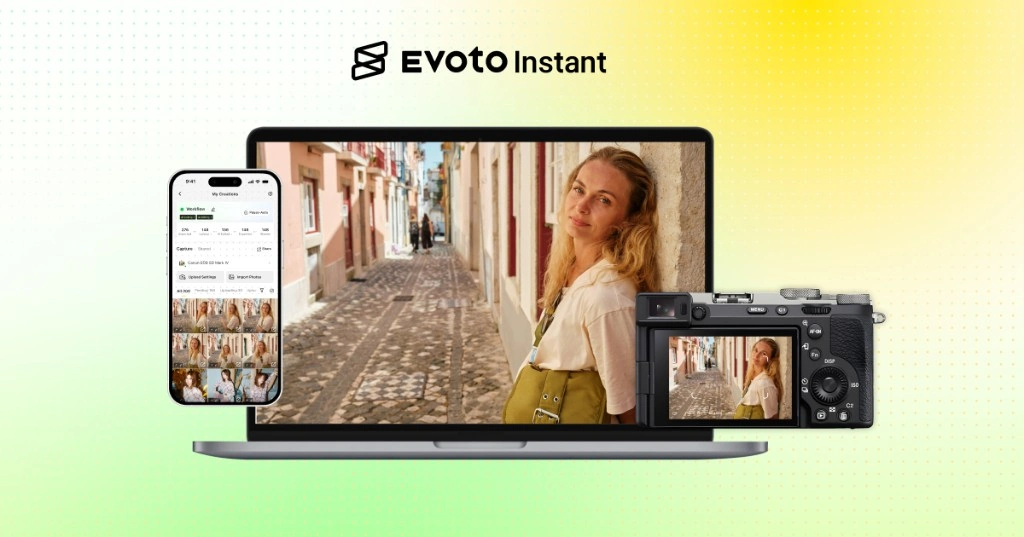
This article compares the most common delivery methods photographers use today, then looks at where a platform like Evoto Instant may fit for event, wedding, school, and other client-facing jobs.
Why traditional file delivery starts to break down
Many photographers begin with simple delivery methods. They send a Dropbox link, a Google Drive folder, a WeTransfer transfer, or even compressed files by email. Those methods can work for one-off jobs, but they often create friction as soon as the project gets larger or the delivery becomes more client-facing.
Large files are difficult to send by email. Shared folders can feel messy and unbranded. Download quality can become confusing. Clients may not know which images to view first, whether they are allowed to share the link, or how to find the photos that matter most to them.
That friction becomes even more obvious in event, wedding, school, and high-volume photography. In those environments, you are often not delivering to one person. You may be delivering to a couple, a planner, a parent, a team, or hundreds of guests.
At that point, “send the files” is no longer a real delivery strategy.
What clients actually expect from photo delivery
Clients usually want four things from a delivery experience:
- Fast access
They do not want to wait days for a manual handoff once photos are ready. - Clear navigation
They want a simple place to browse, select, and download images. - Reliable quality
They want the right files in the right format without accidental compression or confusion. - Confidence and control
Private jobs, family events, schools, and brand work often need more than an open file link. Access control matters.
The best way to deliver photos to clients should meet all four of those expectations at once.
Common ways photographers deliver photos to clients
Let us compare the most common methods.
Email attachments
Best for a few low-resolution preview files. Email is easy, but it breaks quickly when file sizes grow. It is not ideal for full delivery, especially if you need clients to browse many images.
Cloud storage folders
Shared drives are familiar, but they often feel like storage, not delivery. They rarely provide a polished presentation, and they usually require more client explanation.
File transfer tools
Transfer links are good for quick handoff, but they are temporary and transactional. They do not create an ongoing client gallery experience.

Messaging apps
These are convenient for casual communication, but they are poor delivery tools. Files may be compressed, hard to organize, and impossible to manage at scale.
Client galleries
For many photographers, this is the most complete option. A client gallery gives viewers a structured place to access photos, while the photographer keeps control over access, downloads, branding, and sharing.
Why client galleries are usually the better answer
A strong client gallery system turns delivery into part of the service, not just the final admin step.
Instead of asking clients to open a generic folder and guess what to do next, you can give them a dedicated gallery with a clear browsing experience. That matters for portrait sessions, but it matters even more for event photography where many people may need different ways to enter the same project.
In a gallery-first setup, you can:
- share a complete gallery for broad browsing,
- create more private access for selected viewers,
- control download permissions,
- keep branding consistent,
- and reduce the number of manual follow-up messages.
This is where a modern photo delivery website or client gallery platform can become more valuable than a simple file transfer tool.
When photographers compare tools more seriously, the best way to deliver photos to clients is often the option that combines presentation, access control, and a cleaner viewing experience in one place.
How Evoto Instant approaches gallery delivery
Evoto Instant is a cloud-based photo delivery platform for photographers, with both web and mobile app experiences. Photographers can use it to manage projects, publish galleries, and deliver photos to clients and guests through multiple access methods.


and Share Photos in Real Time
With Instant, photographers can publish delivery-ready galleries, share them through QR code, email, or SMS, and support different access experiences depending on the job. A full gallery can support broad browsing. Interact can help photographers create more person-specific delivery paths. Find Me can help viewers locate their own photos faster through face-based matching.
That makes Instant especially relevant for photographers working in event and high-volume scenarios where delivery is not only about file transfer, but also about access, routing, privacy, and viewer experience.
What makes gallery delivery especially useful for event and high-volume work
In event photography, delivery is not only about getting files online. It is about routing the right photos to the right people with as little friction as possible. For many photographers, this is a key part of finding the best way to deliver photos to clients.
That is why a connected delivery system matters. In Evoto Instant, photographers can import photos, move them through optional AI editing, and publish them into a delivery-ready gallery system. From there, photos can be shared through multiple entry methods such as QR code, email, or SMS.
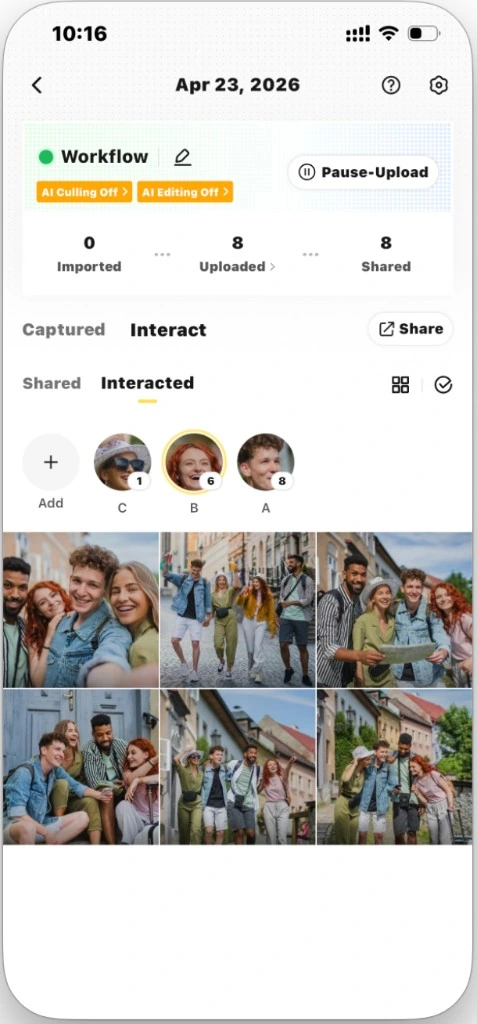
For broader access, a full gallery can work well. For more personalized delivery, photographers can create person-specific galleries through Interact. For guest-side discovery, Find Me can help viewers surface their own photos faster through face-based matching.
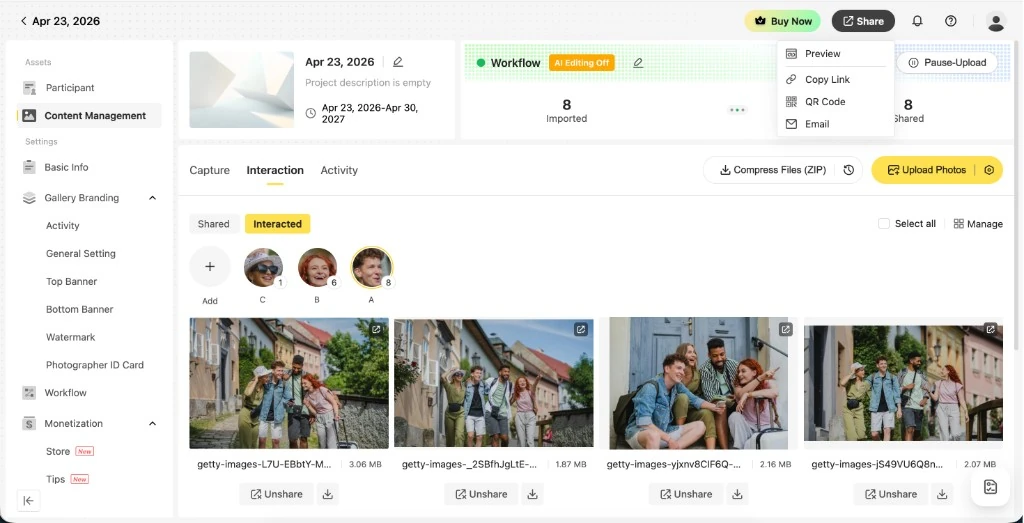
For many event-driven jobs, this type of structure is more useful than sending one raw folder link to everyone and hoping they figure it out. In practice, it can be a more scalable and efficient answer for photographers looking for the best way to deliver photos to clients.
How to choose the best delivery method for your business
If you mainly deliver a few retouched images to one contact, a file transfer tool may still be enough.
But if any of the following are true, a gallery-based system is often the better choice:
- you deliver to multiple people,
- clients need a cleaner viewing experience,
- you want more control over downloads,
- you need privacy or access restrictions,
- you want to present your brand professionally,
- or you want to build future sales or upsell options into delivery.
That last point matters more than many photographers realize. Delivery is not only an operational step. It is also part of the client experience. A better delivery process can help make the handoff feel smoother, more professional, and easier to manage.
What to look for in a photo delivery platform
If you are evaluating options, look for a delivery platform that gives you:
- gallery-based presentation,
- private links or access codes,
- multiple sharing methods,
- download controls,
- watermarking or protective overlays,
- branding options,
- and support for high-volume jobs.
If you shoot events, schools, sports, or weddings, it is also worth looking for person-specific delivery options and analytics that show how galleries are being used.
Those details often make the difference between “a place where files live” and “a platform that actually helps you deliver photos to clients.”
Final thoughts
So what is the best way to deliver photos to clients?
For many professional photographers, the answer is not email, not a zip file, and not a generic cloud folder. A client-friendly gallery platform is often the stronger option because it gives viewers easy access while giving you control over how delivery works.
That approach is often faster, clearer, and easier to scale. It also reflects what many modern clients already expect: a delivery experience that feels just as polished as the photography itself.
If your current process still feels manual, confusing, or difficult to scale, moving to a gallery-based delivery platform may be one of the clearest upgrades you can make.
If you are exploring a more modern way to deliver photos, Evoto Instant is worth a closer look. It gives photographers a cloud-based delivery platform across web and mobile, with galleries, multiple sharing methods, and more flexible access options built in.
If you are still deciding on the best way to deliver photos to clients, it is worth comparing not only how files are sent, but also how the full delivery experience feels to the people receiving them.
and Share Photos in Real Time